Prophetic Gloss: Palm Sunday
Zechariah 9:9 King of Peace and the Eschatological Warrior-King of kings of Revelation 19
I. Introduction
Palm Sunday marks the triumphal entry of Jesus Christ into Jerusalem, an event explicitly framed by the Gospel writers as the fulfillment of the Book of Zechariah 9:9. Yet this scene stands in striking tension with the apocalyptic portrayal of the Messiah in the Book of Revelation 19:11–16, where the same figure appears not in humility but in militant glory.
This excursus argues that these texts are not contradictory but diachronically complementary, revealing a two-stage messianic mission: humiliation followed by exaltation, salvation preceding judgment.
II. Zechariah 9:9 — The Humble King
A. Hebrew Text and Transliteration
הִנֵּה מַלְכֵּךְ יָבוֹא לָךְ
צַדִּיק וְנוֹשָׁע הוּא
עָנִי וְרֹכֵב עַל־חֲמוֹר
וְעַל־עַיִר בֶּן־אֲתֹנוֹת
Transliteration: hinnēh malkēk yābô lāḵ, ṣaddîq wĕnôšāʿ hûʾ, ʿānî wĕrōkēb ʿal-ḥămôr…
B. Morphological and Lexical Analysis
צַדִּיק (ṣaddîq) — Qal adjective; denotes ethical righteousness and covenant fidelity.¹
וְנוֹשָׁע (wĕnôšāʿ) — Niphal participle; passive/reflexive: “having been delivered” or “vindicated.”²
עָנִי (ʿānî) — adjective; “afflicted, poor, oppressed,” often associated with the righteous sufferer.³
רֹכֵב (rōkēb) — Qal participle; continuous action: “riding.”
C. Syntactical Observation
The coordination צַדִּיק וְנוֹשָׁע creates a paradox:
A king who is righteous
Yet one who is “saved/delivered.”
This suggests not merely a victorious monarch, but one who passes through affliction into vindication, anticipating a suffering-then-glory pattern.
D. Septuagintal Transformation
The LXX renders:
נוֹשָׁע → σῴζων (saving)
עָנִי → πραΰς (gentle/meek)
This shifts:
From passive deliverance → active salvation
From affliction → character quality
The New Testament follows this LXX trajectory, especially in Matthew 21:5, emphasizing Jesus as the agent of salvation, while the Hebrew nuance is fulfilled in His resurrectional vindication.
III. The Donkey Motif in Ancient Near Eastern Context
The donkey (חֲמוֹר, ḥămôr) symbolizes:
Peaceful kingship (cf. 1 Kings 1:33, Solomon)
Civil authority rather than military aggression
In contrast:
Horses signify warfare and conquest
Thus, Zechariah intentionally depicts a non-militaristic king, subverting expectations of a Davidic warlord.
IV. Second Temple Messianic Expectations
During the Second Temple period, dominant expectations (e.g., Psalms of Solomon 17) envisioned:
A conquering Davidic king
Political liberation from foreign powers
Absent—or underdeveloped—was the category of:
A suffering, afflicted Messiah
One who is rejected, killed, and vindicated
Thus, Zechariah 9:9 and Isaiah 53 were not commonly synthesized.
V. Gospel Fulfillment: The Triumphal Entry
The Gospels present the triumphal entry as a deliberate enactment of Zechariah 9:9:
Gospel of Matthew 21:4–5 — explicit quotation
Gospel of John 12:14–15 — interpretive fulfillment
Jesus’ choice of a donkey is not incidental—it is a self-conscious messianic claim, yet one that redefines kingship through humility.
VI. Revelation 19:11–16 — The Warrior-King
A. Greek Text (Key Clause)
καὶ ἰδοὺ ἵππος λευκός…
καὶ ἐν δικαιοσύνῃ κρίνει καὶ πολεμεῖ
B. Morphological Observations
ἵππος λευκός — white horse; symbol of victory and conquest
κρίνει (present active) — “he judges.”
πολεμεῖ (present active) — “he wages war”
ἐν δικαιοσύνῃ — righteousness governs both actions
C. Aspectual Insight
The present tense verbs function as prophetic presents, portraying vivid, decisive, and ongoing action within the apocalyptic vision.
D. Intertextual Background
Revelation 19 draws heavily on:
Book of Isaiah 63:1–6 — divine warrior imagery
Book of Psalms 2:9 — rod of iron
Book of Daniel 7:13–14 — universal dominion
Thus, the Messiah appears as the eschatological warrior-king.
VII. Donkey vs. White Horse — A Theological Contrast
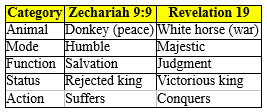
Triumph of Prince of Peace vs. Triumph of Warrior King
There is a tremendous contrast between the two entrances effected by the Lord Jesus Christ. The first is as the King of Peace, the second is as the King of kings. The Jewish leaders rejected the first King of Peace and were ultimately exiled in A.D. 70 until the nation was reconstituted in A.D. 1948. They were only looking for the King of kings to conquer the Romans and establish their rule.
VIII. The Righteousness Motif
Both texts center on righteousness:
Zechariah: צַדִּיק (ṣaddîq)
Revelation: ἐν δικαιοσύνῃ
Yet:
First coming → righteousness saves
Second coming → righteousness judges
IX. The Two-Stage Messianic Paradigm
The tension resolves in a chronological framework:
Stage 1 — Humiliation
Donkey
Cross
Rejection
Atonement
Stage 2 — Exaltation
White horse
Judgment
Dominion
Universal recognition
This sequence is explicitly affirmed in the Gospel of Luke 24:26:
“Was it not necessary that the Christ should suffer these things and then enter into his glory?”
X. The Cross as the Interpretive Center
The cross stands between:
Zechariah 9:9 (entry in humility)
Revelation 19 (return in glory)
It is the pivot:
Without it → no basis for salvation
Without the second coming → no final justice
XI. Eschatological Implications
We presently live in the inter-advent period:
The King has come (donkey)
The King will return (white horse)
Thus:
Salvation is still extended
Judgment is still future
XII. Conclusion
The juxtaposition of Zechariah 9:9 and Revelation 19 does not present two different Messiahs, but one Messiah in two phases of redemptive history.
The same Jesus Christ:
Came first as the afflicted and humble king (עָנִי)
Returns as the righteous warrior who judges and wages war (κρίνει καὶ πολεμεῖ)
Final Summary Statement
The Messiah of Zechariah 9:9, described as צַדִּיק וְנוֹשָׁע (righteous and vindicated), is revealed in Revelation 19 as the eschatological agent who “judges and wages war in righteousness,” thereby demonstrating a progressive, two-stage realization of messianic identity across redemptive history.
Footnotes
1. Francis Brown, S. R. Driver, and Charles Briggs, Hebrew and English Lexicon of the Old Testament (Oxford: Clarendon, 1907), 843.
2. Ludwig Koehler and Walter Baumgartner, The Hebrew and Aramaic Lexicon of the Old Testament (Leiden: Brill, 1994), 854.
3. Ibid.
4. Henry Barclay Swete, An Introduction to the Old Testament in Greek (Cambridge: Cambridge University Press, 1914), 265.
5. G. K. Beale and D. A. Carson, eds., Commentary on the New Testament Use of the Old Testament (Grand Rapids: Baker, 2007), 708.
6. Richard Bauckham, Jesus and the God of Israel (Grand Rapids: Eerdmans, 2008), 56–60.
