Question
Does the Bible teach that the earth is flat, or does Scripture support a spherical earth? Is flat-earth teaching properly considered false doctrine when it is presented as a required Christian belief, and what spiritual harm can result from attaching flat-earth cosmology to the authority of Scripture?
Short Answer
The Bible does not teach that the earth is a flat disk. Neither does Scripture contain a technical geometrical statement declaring, “the earth is a sphere.” Rather, the cumulative testimony of Scripture describes an earth characterized by circularity, suspended “on nothing,” possessing a divinely established boundary associated with light and darkness, and experiencing the ordered cycles of day and night, sunrise and sunset. These descriptions are fully consistent with, and collectively more naturally comport with, a spherical earth.
Isaiah 40:22 describes חוּג הָאָרֶץ (ḥûg hāʾāreṣ), “the circle/circuit of the earth.” The Septuagint renders this τὸν γῦρον τῆς γῆς (ton gyron tēs gēs), likewise expressing circularity. Neither ḥûg nor gyros technically means “sphere.” Indeed, Isaiah uses כַּדּוּר (kaddûr), “ball,” elsewhere (Isa. 22:18). Thus Isaiah 40:22 alone cannot distinguish a spherical earth from a circular disk. The biblical case becomes stronger when Isaiah is read with Job 26:7, 10; Proverbs 8:27; Genesis 1:4–18; Psalm 19:4–6; Psalm 104:19–23; and Ecclesiastes 1:5.
A Christian who simply holds an erroneous cosmological opinion has not thereby denied the gospel. Flat-earth belief becomes false doctrine in the relevant sense when teachers claim that God has revealed a flat earth, make acceptance of that proposition a test of biblical fidelity, or accuse Christians who accept a spherical earth of rejecting Scripture. Such teaching adds a proposition to God’s revelation that Scripture itself does not establish (Deut. 4:2; Prov. 30:5–6).
Biblical Analysis
1. Isaiah 40:22 Establishes Circularity, Not Necessarily Sphericity
Isaiah describes God as: “He who sits above the circle of the earth” (Isa. 40:22). The Hebrew expression is חוּג הָאָרֶץ (ḥûg hāʾāreṣ), “circle/circuit of the earth.” The ancient Jewish translators of the Septuagint rendered the expression τὸν γῦρον τῆς γῆς (ton gyron tēs gēs), “the circle/circuit of the earth.” The Hebrew and Greek therefore agree upon the concept of circularity.
However, this evidence must not be overstated. A flat-earth advocate can correctly observe that something may be circular without being spherical: a coin is round but flat. That objection demonstrates why Isaiah 40:22 cannot stand alone as proof of a spherical earth.
Moreover, Isaiah himself uses כַּדּוּר (kaddûr), “ball,” in Isaiah 22:18. Yet Isaiah does not call the earth a kaddûr in Isaiah 40:22. Therefore, חוּג (ḥûg) does not prove “sphere.” But the opposite conclusion is equally unwarranted: חוּג (ḥûg) does not mean “flat disk.” Isaiah establishes circularity. The remaining question must be answered from the cumulative testimony of Scripture.
2. Job Describes an Earth Suspended Upon Nothing
Job declares: “He stretches out the north over the void and hangs the earth on nothing” (Job 26:7). The Hebrew expression is תֹּלֶה אֶרֶץ עַל־בְּלִי־מָה (tōleh ʾereṣ ʿal-belî-māh). God “hangs the earth upon nothing.” Job does not portray the earth as physically resting upon another material structure. Although this does not prove sphericity, it contributes another component to the biblical picture: the earth is suspended.
3. Job 26:10 May Be the More Significant Cosmological Text
Job continues: “He has inscribed a circle on the face of the waters at the boundary between light and darkness” (Job 26:10). Here Scripture brings together three concepts: circular boundary + light + darkness.
The Hebrew concludes תַּכְלִית אוֹר עִם־חֹשֶׁךְ (taḵlîṯ ʾôr ʿim-ḥōšeḵ), that is, the boundary or extremity of light with darkness. This is significant because illumination of a spherical body by a distant light source necessarily creates a moving boundary between its illuminated and dark portions. Modern astronomy calls this boundary the terminator.
Job is not using modern astronomical terminology, and Scripture should not be made to say more than it says. Nevertheless, the description is remarkably consonant with the physical characteristics of an illuminated sphere. This strengthens the spherical interpretation beyond Isaiah’s simple statement of circularity.
4. Genesis Establishes the Biblical Light-and-Darkness Framework
At creation, “God separated the light from the darkness. God called the light Day, and the darkness he called Night” (Gen. 1:4–5). The Hebrew categories are אוֹר (ʾôr), “light,” and חֹשֶׁךְ (ḥōšeḵ), “darkness.” These are precisely the concepts appearing together in Job 26:10.
Genesis 1:14–18 subsequently associates the heavenly luminaries with the regular distinction between day and night. Following the Flood, God promises that “day and night” will continue (Gen. 8:22). The canonical picture is therefore one of an ordered, recurring transition between illumination and darkness.
5. The Physics of Day and Night Is Consistent With a Sphere
If the earth were a flat disk and the Sun literally traveled below the disk and then rose above its edge, ordinary optics would create a substantial difficulty. Once an unobstructed Sun cleared the plane of the disk, its light would be available across the plane rather than producing the progressive east-to-west transition between darkness, dawn, daylight, sunset, and darkness characteristic of an illuminated sphere.
Some modern flat-earth models therefore propose something different: a relatively small, nearby Sun that remains above the disk and moves in a circle, illuminating only a localized portion of the surface like a spotlight. But Scripture teaches neither a small local Sun nor a spotlight mechanism restricting its illumination. Those propositions must be supplied from outside Scripture.
By contrast, the spherical model naturally accounts for a moving boundary between light and darkness of precisely the general character described in Job 26:10. This does not transform Job into a modern astronomy textbook. It does demonstrate that the spherical model requires no special extrabiblical mechanism to reconcile the biblical observations.
6. Scripture’s Sunrise and Sunset Language Does Not Require a Stationary Earth
Ecclesiastes says, “The sun rises, and the sun goes down, and hastens to the place where it rises” (Eccl. 1:5). Psalm 19 similarly describes the Sun’s apparent course across the heavens (Ps. 19:4–6), while Psalm 104 associates sunset with darkness and sunrise with renewed human activity (Ps. 104:19–23).
These are phenomenological descriptions—descriptions of phenomena from the perspective of the observer. People today routinely speak of sunrise and sunset without thereby asserting geocentrism. Consequently, the biblical statement “the sun rises” cannot legitimately be converted into the scientific proposition: “The earth is stationary and the Sun physically travels around it every twenty-four hours.” The text describes what the observer sees rather than specifying the physical mechanism producing the observation.
7. Joshua 10 Does Not Establish a Stationary or Flat Earth
Joshua commanded, “Sun, stand still at Gibeon, and moon, in the Valley of Aijalon” (Josh. 10:12). Scripture subsequently reports, “And the sun stood still, and the moon stopped” (Josh. 10:13). The purpose of the miracle was prolonged daylight. The passage describes the observable phenomenon without explaining the physical mechanism by which God accomplished it. Thus Joshua 10 teaches a supernatural prolongation of daylight. It does not establish flat-earth cosmology or require geocentrism.
8. The Biblical Evidence Is Cumulative
The argument should therefore not be: “Isaiah 40:22 says ḥûg; ḥûg means sphere; therefore the Bible teaches a spherical earth.” The lexical premise is too strong. The better argument is cumulative:
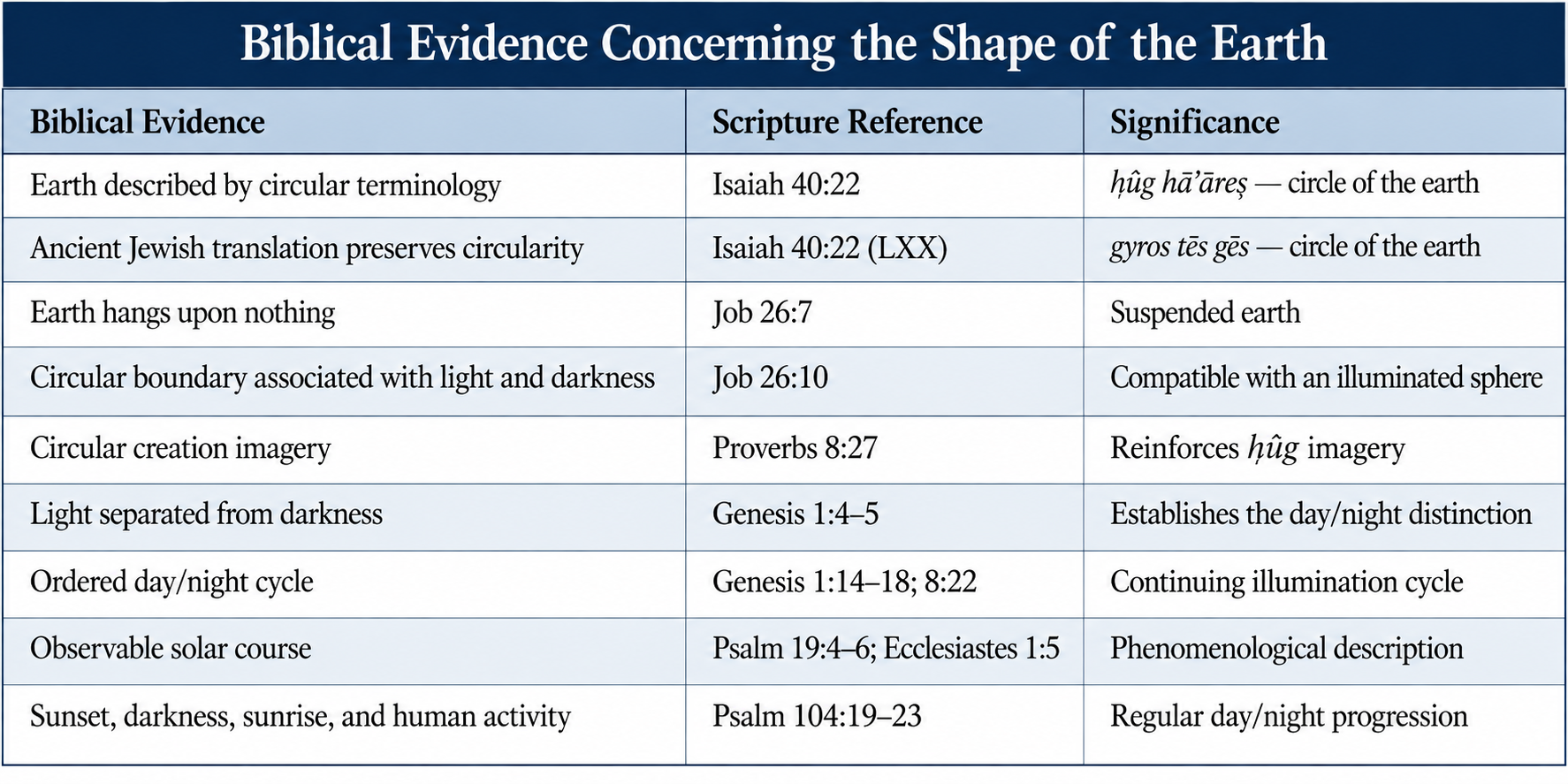
The cumulative biblical picture is therefore entirely compatible with a spherical earth and does not require a flat earth.
When Does Flat-Earth Belief Become False Doctrine?
A distinction is necessary. A Christian may simply be mistaken about cosmology. Salvation does not depend upon possessing correct astronomical knowledge. The gospel concerns Christ’s death for sins, burial, and bodily resurrection (1 Cor. 15:1–4), and justification is by grace through faith (Eph. 2:8–9).
The theological problem arises when someone teaches: “The Bible teaches that the earth is flat. Therefore, accepting a spherical earth constitutes rejection of biblical authority.” At that point a scientific or cosmological theory has been transformed into a doctrinal requirement.
Scripture expressly warns: “You shall not add to the word that I command you, nor take from it” (Deut. 4:2). And: “Every word of God proves true.... Do not add to his words, lest he rebuke you and you be found a liar” (Prov. 30:5–6). The error is therefore more serious than incorrect cosmology. It is attributing to God something God has not revealed and binding Christian conscience to it.
What Does the Enemy of Christ Gain From Such Teaching?
Scripture identifies Satan as “the father of lies” (John 8:44), “the deceiver of the whole world” (Rev. 12:9), and one who can disguise himself “as an angel of light” (2 Cor. 11:14). This does not justify alleging without evidence that scientists, governments, or particular institutions have deliberately conspired to produce flat-earth teaching. Scripture requires no such speculation. Rather, Scripture permits us to identify the spiritual advantages produced whenever Christians embrace falsehood in the name of God’s Word.
1. Scripture’s Credibility Is Unnecessarily Damaged
If an unbeliever is told, “Christianity requires belief in a flat earth,” and subsequently determines that the earth is spherical, he may conclude not merely that the Christian interpreter was mistaken, but: “The Bible has been disproved.” The error of the interpreter has thereby been falsely attached to the authority of Scripture. Paul warns of circumstances in which God’s reputation is damaged before unbelievers: “The name of God is blasphemed among the Gentiles because of you” (Rom. 2:24; cf. Isa. 52:5).
2. Christians Become Distracted From Their Actual Mission
Christ commanded, “Go therefore and make disciples of all nations” (Matt. 28:19). Paul commanded Timothy, “Preach the word” (2 Tim. 4:2). Yet only verses later Paul warns that people “will turn away from listening to the truth and wander off into myths” (2 Tim. 4:4). The Greek μύθους (mythous) denotes myths or fabricated narratives. An enormous investment of Christian energy into proving an extrabiblical cosmology can therefore displace attention from Christ, the gospel, discipleship, holiness, evangelism, and sound doctrine.
3. Artificial Division Is Introduced Into the Church
Paul commands, “Have nothing to do with foolish, ignorant controversies; you know that they breed quarrels” (2 Tim. 2:23). And: “Avoid foolish controversies ... for they are unprofitable and worthless” (Titus 3:9). Declaring flat-earth belief a mark of biblical faithfulness creates a test of orthodoxy that Christ and His apostles never created. Christians may then begin questioning one another’s commitment to Scripture over a proposition Scripture never made an article of faith.
4. Poor Hermeneutics Are Reinforced
Flat-earth arguments often depend upon treating figurative, poetic, or phenomenological language as technical scientific terminology: “four corners of the earth” (Isa. 11:12); “ends of the earth” (Isa. 45:22); “foundations of the earth” (Ps. 104:5); and the Sun “rises” and “goes down” (Eccl. 1:5).
But Satan himself demonstrates that merely quoting Scripture does not make an interpretation biblical. During Christ’s temptation, Satan quoted Psalm 91 (Matt. 4:6). The words were Scripture; the interpretation and application were wrong. Jesus responded with Scripture properly interpreted in context (Matt. 4:7). Thus a doctrine does not become biblical merely because Bible verses are cited in its support.
5. Suspicion Can Replace Biblical Discernment
Scripture does not command Christians to accept propositions merely because recognized authorities teach them. But neither does Scripture command Christians to reject propositions merely because recognized authorities teach them. Instead: “Test everything; hold fast what is good” (1 Thess. 5:21). The Greek δοκιμάζετε (dokimazete) means to examine, test, or prove. The Bereans exemplified this method by “examining the Scriptures daily to see if these things were so” (Acts 17:11). Biblical epistemology therefore rejects both uncritical acceptance and reflexive suspicion. The Christian tests truth claims.
Conclusion
The Bible does not contain the technical geometrical statement, “The earth is a sphere.” Therefore Christians should not pretend that it does. But neither does Scripture teach a flat earth.
Rather, Scripture describes an earth possessing circularity (Isa. 40:22), hanging “on nothing” (Job 26:7), possessing a circular boundary associated with light and darkness (Job 26:10), and participating in God’s ordered cycles of daylight, darkness, sunrise, and sunset (Gen. 1:4–18; Ps. 19:4–6; 104:19–23; Eccl. 1:5). Taken cumulatively, these descriptions are naturally compatible with a spherical earth and require none of the auxiliary mechanisms necessary for the principal flat-earth models.
The central theological problem with flat-earth doctrine, therefore, is not merely that its cosmology is mistaken. It is that when flat-earth theory is proclaimed as biblical doctrine, something God has not revealed is attributed to God’s Word.
That creates precisely the kind of spiritual opportunity Scripture warns against: truth is exchanged for error, Christians are distracted by controversies, believers divide over matters God did not establish as doctrine, poor hermeneutics become normalized, and unbelievers may be encouraged to reject Scripture because Christians have unnecessarily attached Scripture’s authority to a false proposition.
Christianity has nothing to fear from objective truth. God cannot lie (Num. 23:19; Titus 1:2). Christ is “the truth” (John 14:6), and God’s Word “is truth” (John 17:17). Accordingly, the proper biblical posture is neither credulity nor conspiratorial suspicion, but the Berean method: “Test everything; hold fast what is good” (1 Thess. 5:21), examining the Scriptures “to see if these things were so” (Acts 17:11).
That is the sound theological distinction between biblical authority and flat-earth theology. Keep in mind, the issue is not a central issue to the Christian faith and should not be a source of divide among believers. When the Bible is not absolutely clear and provides a mystery believers should consider Deuteronomy 29:29::
“The secret things belong unto the LORD our God: but those things which are revealed belong unto us and to our children forever, that we may do all the words of this law.”